
No Zero Days in Remote Viewing Practice
4:00 PM. Friday. Dec 19, 2025.
My day is packed. Like it always is.
Morning routine. Workout. 3 calls. Deep feedback on 2 new features. 2 interviews. Then the inbox. A quick tip for a user on Tetrad Lifeform.
And somehow… I'm also supposed to make it to a meetup with friends.
Somewhere inside all of that… there's remote viewing (RV) practice.
Last Friday looked like this. Yesterday too.
The day before that — same story.
I catch myself thinking the same thing every time:
How do you keep up with life… without dropping the practice?
Here's the weird part
Missing a work task doesn't sting the same way. Missing practice does.
The feeling is heavier.
Like pressure.
Like guilt.
Like a little drip of apathy that shows up right on schedule.
Even if, logically, replying to the accountants about the latest tax report is "more important."
You never reach that level of ESP (extrasensory perception) — not because it's impossible, but because you keep up with the social treadmill.
For a lot of us, that's the deal.
What a joke.
"I'll have 20 minutes," I think, as I call a taxi.
Yeah — a taxi.
This time I'm optimizing my time. And I'm spending it on the one thing I don't want to lose: 20 minutes of RV training.
Sure, the ideal session is 40–90 minutes. But let's be honest — unless you live in a monastery or a scenic cave, that's not always possible.
I love proper preparation before ESP training. Results are better. But today's social matrix forces different conditions.
No Perfect Setup
Russell Targ and Hal Puthoff made a point in "Mind Reach" that I keep coming back to: Slow down for one minute.
No elaborate ritual.
No "perfect" meditation setup.
Just a tiny reset that makes practice possible again.
This is exactly why I built VEREVIO.
Not for the perfect quiet room.
For real life — when time is short, but you refuse to lose the habit.
No zero days. Even 15 minutes of training compounds over a long timeline.
Start small, stay consistent.
Daily. Or every other day.
EarPods in. I'm in the taxi.
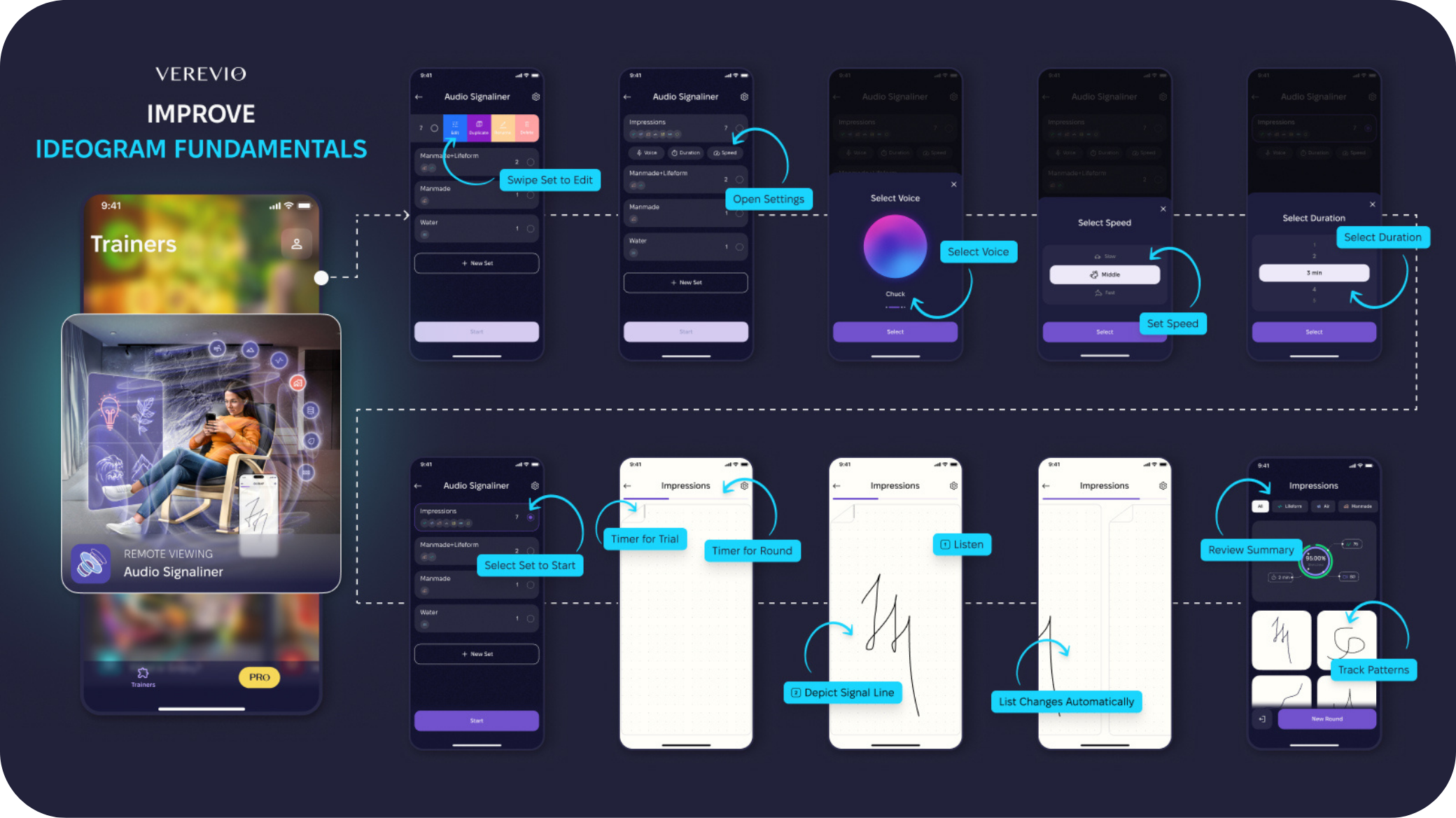
I start a 2-minute round in Audio Signaliner. The ideograms are steady. That feeling shows up — the good one.
Yep. I'm locked in.
"Manmade." I hear it — and my hand is already drawing clean right angles.
"Lifeform." My brain hasn't even formed a thought yet. The hand is already making that little circle-with-a-tail on the in-app whiteboard.
Audio Signaliner Hack
Before I throw the ideogram, I trace the number on the screen.
It's a "dumb" task on purpose. It keeps the analytical brain busy.
So it can't jump in and force a remembered ideogram pattern.
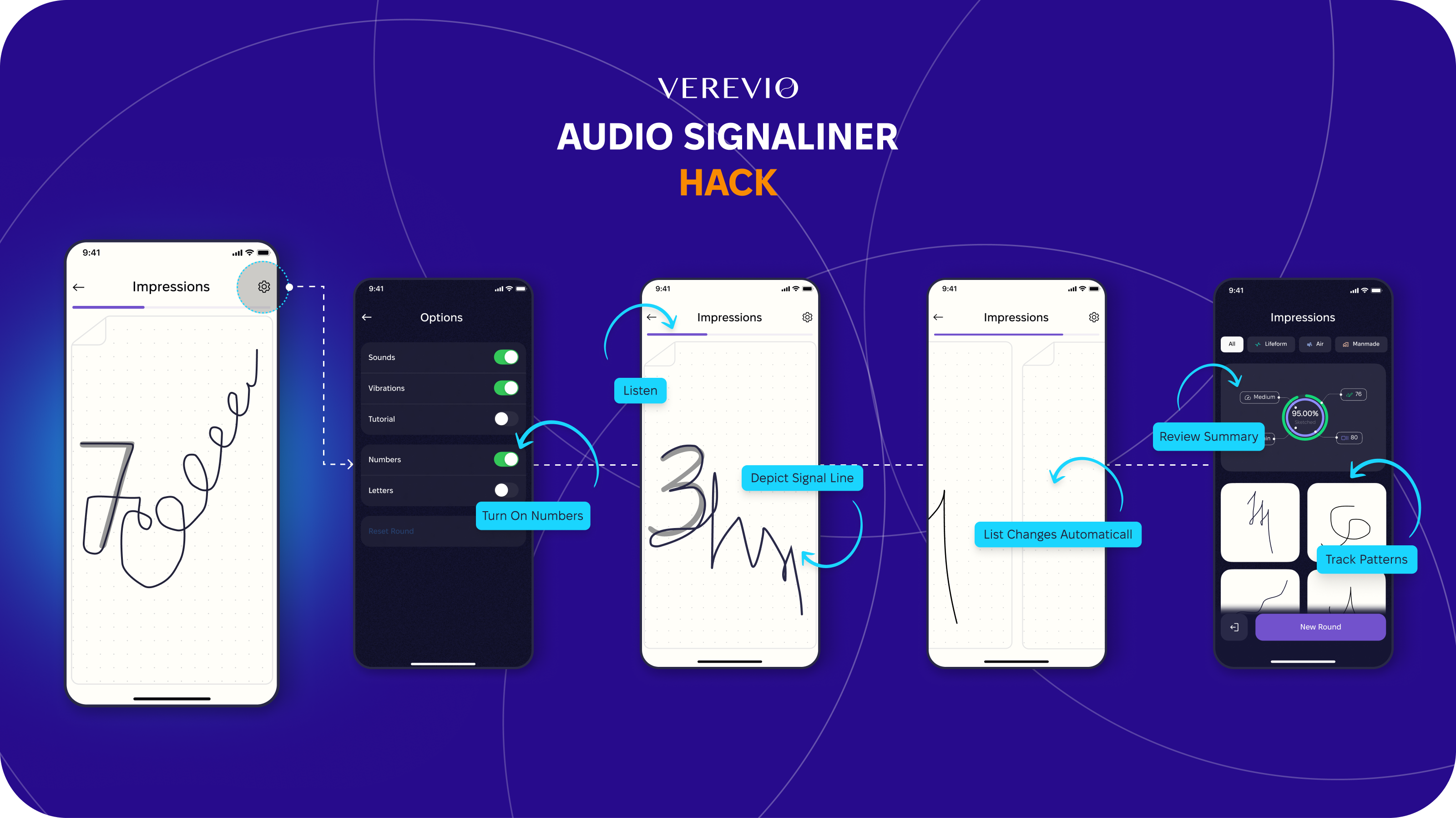
"Movement." I finish tracing the 7… and my hand snaps into that familiar upward curl. It starts to feel like a conditioned reflex. That's the point.
Your job isn't to draw it pretty. Your job is to produce a simple mark that, over time, crystallizes into a pattern tied to the target-feel.
Two minutes disappear. Stable. So I go again. Another 2 minutes.
Then the taxi brakes hard — hazards on — traffic jam.
"I'm late," flashes in my head. Okay. More practice time.
I switch to First Impression. Different job: perceive the right gestalt (first impression) on a new target number each time.

You need to jot down a target number like 1234-5678-90 and make an automatic anchor mark to the target — an ideogram.
A Killer Combo
Audio Signaliner + First Impression is a killer combo.
It works as a warm-up and as a full beginner-friendly Stage 1 remote viewing exercise.
The first 5 minutes are messy. It's hard to visually separate ideograms.
But here's the good news: I start to feel the target. Some shapes begin to hold their outline. I feel more attuned to the exercise.
One thing I notice: the ideogram from Audio Signaliner isn't always a 1:1 match with First Impression once a target number is in play. That's normal.
Constant dropping wears away the stone. What matters is the quick, subtle "click" with the target. After that, the ideograms start to pattern themselves.
The next 5 minutes are better.
Shapes hold.
Outlines stick.
My gestalt hit rate climbs.
Suddenly my logical brain tries to sneak in:
"You still need to finish two features in First Impression."
Yep. Noted. It's already in the backlog. Moving on.
End on a High Note
Fifteen minutes fly by. That light, specific fatigue shows up.
I use a rule: if you're getting a good result, stop at the peak.
Got it. I read Manmade clearly. It was a phone — an iPhone X.
"Pretty old one, but VEREVIO should run fine on it," my analytical brain chimes in as the practice ends.
I usually do 2–3 attempts per target.
I jot the target number on the in-app whiteboard and fire the ideogram immediately. Three repeats. Same manmade signal at the end. That either means there isn't much else there, or I can't grab it for whatever reason.
In multiple-choice trainers like First Impression, avoiding a False Positive (wrong pick) and not taking a False Negative (missing the correct option) feels great. I take the win.
Mission accomplished for today. I found time, not excuses.
Tools make that easier.
If you want to copy this right now, keep it simple:
2–4 min Audio Signaliner.
10–15 min First Impression.
Stop on a good result → go live your day.
15–20 minutes matter on a long enough timeline.
Happy holidays.
Comments
0No comments yet. Be the first to comment!